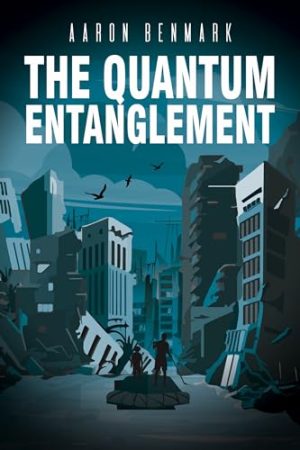
I read this novel for The Self-Published Science Fiction Competition, SPSFC. The following review is my own personal opinion as a judge and does not reflect the views of the team as a whole. Find out more about the competition here and my team, The Space Girls, here, and read all my reviews for the competition here!
America lies in ruins. Nearly a thousand years following the cataclysm that destroyed the world, it has rebuilt itself into many smaller kingdoms, republics, and city states, but the people live simple, desperate lives.
Above all towers the powerful Church of Science, a religious organization that worships the old masters of science, bans technology for all but the wealthiest, and controls society with a velvet glove masking an iron fist.
Deep in the trenches of the Church’s hierarchy sits Cort, a young researcher who wants to be left alone to his studies. To Cort’s surprise, however, he is about to be drafted into a dangerous mission that will take him to the highest levels of Church society…and the lowest. Cort’s mission will test his loyalties, convictions, and beliefs, secretly held against the Church’s scriptures. He must navigate a brewing conflict between the Church and the powerful Scientific American Emperor while not letting his true beliefs come to light…for even the slightest dissidence is punishable by disentanglement, a fate worse than death…
Interestingly, the general setup of this book was quite similar to my previous SPSFC5 read, The Girl in the Tomb: in the far future, climbing out of a tech-caused catastrophe, the remains of the USA are scraping by in a better or worse state, technology is forbidden, and religious governance is significant. The Quantum Entanglement handles this setting completely differently, but it was still interesting to see similar themes and factors coming out from two separate works. It’s neat, what intrigues us about the future and through what lens, and all the fears and hopes that come with it. In this novel, the main character, Cort, was immediately sympathetic to me: a researcher of technology balancing on the very sharp edge between being subversive and being overlooked. As the news of more and more upheaval and technological improvements reach the Free Cities, the center of the Church of Science on the eastern coast of what once was the USA, he and a couple other servants of the Church (a warrior, a data scientist, and a priestess) are sent on a mission to travel around to unearth and report rebellious technology in order to keep the precious peace, and of course, the absolute rule of the Church.
Discovering the various habitats (desolate towns, tightly secured bunkers, farming villages) of this post-apocalyptic, rebuilding society was very cool, while the secrets of the team of travellers and their dynamic was also keeping me entertained. The idea of the separation of science and technology also felt unique: the Church of Science worships “ancient” scientists like Einstein, Curie, or Hawking who led humanity on the road towards knowledge and scientific discovery, but they abhor technological advancements like modern medicine, electricity, or nuclear energy, because they blamed the fall of human society on it: according to known history, catastrophes involving global pandemics and nuclear war were what almost destroyed humanity. Of course, there is an obvious contradiction in that which is not expanded upon for a long time, but we can feel it and see its effect on people’s thinking who follow the Church’s doctrine. The process of entanglement is another interesting factor kind of looming in the background while we follow our sort of Inquisition through the ruins of cities on the east coast then towards the interior of the continent. The Church of Science promises eternal life just like some of the religions in our current time, but their version seems to be quite literal: a quantum-downloading of one’s personality and memories that would live on after their body dies. Consecutively, the biggest punishment is someone’s disentanglement, which is how the Church threatens and sentences people who violate their laws. And that will become part of the main conflict between the Free Cities and the Scientific American Empire whose ruler, Whittian is on a world-conquering mission.
Whittian and his war is the main thread of the book after a while, as our team of Inquisitioners travel farther than initially expected, get involved in diplomatic talks, sieges, then fall victim to different tragedies which take them to newer and newer settings and through harrowing experiences. I have to admit I was not expecting most of the turns the novel’s plot took, but I was enjoying most of the tour we got. There was also a relationship, between Cort and a young orphan boy, Bart, that I quite enjoyed, which ended up having a very nice arc to it. At the same time, I felt like the pacing of the second half of the book was a bit uneven with long periods of not much happening, but then suddenly shifting to a lot of action and plot turns, some of which I would have wanted explored more in detail. There was sufficient time spent on getting to know the different characters, however, sometimes their backstories that they told in their own POV jarred me out of the flow of the book. And through most of the novel I missed a stronger drive for Cort, too: his doubts and internal battles around the Church’s doctrines were valid and interesting, but I was waiting for a turn or a decision, something more solid, from him. That drive and decision did arrive eventually however, and I found myself really enjoying the finale of the book, even if I wanted a more definitive conclusion to some of the aspects of the book.
The Quantum Entanglement is an imaginative sci-fi novel with enjoyable world-building and interesting discussions around power, knowledge and who controls it, and about humanity’s technological advancements and what futures might be possible with them.


Leave a Reply