I read this novel for The Self-Published Science Fiction Competition, SPSFC. The following review is my own personal opinion as a judge and does not reflect the views of the team as a whole. Find out more about the competition here and my team, The Space Girls, here, and read all my reviews for the competition here!
The Earth and humanity had finally begun to recover from the disastrous rule of the Metal Gods, nigh immortal machines that had pushed both the planet and all living things to the brink. The Ice Age was finally ending, and humanity was starting to spread its wings again into a new, yet familiar world.
But the strife that had preceded the Metal Gods rise had never completely gone away. The surviving enclaves of humanity again began to push on each other, promising to renew old conflicts and grudges. And in those tense times, a young revolutionary makes a potentially dangerous discovery.
That gods can be very hard to kill.
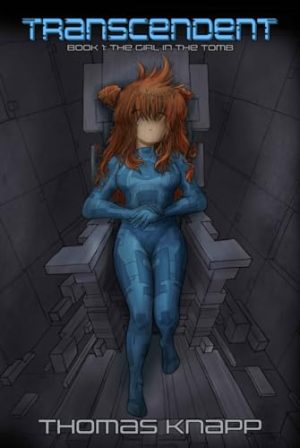
The Girl in the Tomb started out slightly whimsical for me, mostly because of the character of William, a clumsy scientist type from a country called Cascadia on a research mission to dig up a so-called Transcendent tomb, an ancient facility built by the enigmatic, android-type rulers of Earth several thousands of years ago who lifted up, then managed to completely destroy human civilization. After the destruction, humanity is just now climbing out of the effects of that fall and a following ice age, gaining more stability and more knowledge to turn to discovery and restoration. William’s job is not easy: to be successful in revealing more about the Transcendent age, he needs to collaborate with agents from the Holy American Republic, a very conservative state, led by a Pope and heavily biased against any kind of technology for its citizens, and even more so if that is derivative of any kind of Transcendent tech. By the end of the first chapter, however, we realize William isn’t so vulnerable and innocent as we first thought. Still, releasing the titular “Girl in the Tomb”, Alyssia, a Metal God of ancient times, forces him (and Alyssia) into a chase with agents of the Republic, and the strange road trip (or hike, I suppose) leads us into several more intriguing Transcendent ruins, more than one confrontation with expected and unexpected enemies, and to discover a strange, hidden conspiracy that might once again lead humanity into catastrophe.
The book’s structure and pace are unique. Its chapters are labeled as “episodes” and are quite long, almost as if I was truly watching a mini-series or something. The writing takes its time introducing us to the world and certainly can be called “wordy”, however, the voice and the topic of the narration is usually so intriguing that I found myself not really minding any of this. The dynamic between Alyssia and William is also really entertaining. Alyssia is, undoubtedly, a god: even with less resources and the lack of upkeep on her immortal body, her capabilities, both physical and mental, far surpass any of the humans around her, and she’s truly haughty and mean about it sometimes. To her, humans are tools, or like animals of burden. At the same time, she has lived with them, around them, her whole life, and was, is connected to them and their world with thousands of surprising little threads. As the understanding between her and William deepens, it was just really nice to see her unfold and become more and more honest and vulnerable. I really liked her character. And she’s got a lot to say, too: a whole lost history of the rise and fall of the Transcendents, their bonkers technological advances, and some really peculiar discussions about the universe, all of which I loved to discover. There was a very peculiar mood to the entire setting that reminded me of the world of Horizon Zero Dawn a bit, weirdly. And of course, I love hidden lore and lost history in books so it was just the perfect topic for me.
Meanwhile, the road trip goes on and it leads us into unexpected directions. A lot of this book is composed of someone telling a story or the characters strolling about weird settings as we hear Alyssia talk about them, but we do have action as well, especially towards the end. We also get to know much more about the Republic and the Pope, a society that is truly uncomfortable to read about especially in our Current Times, from the POV of another cool character. This part, I felt, received less time than I wished for it, and although I was almost certain the book would end in an open way, for me, the ending petered out a bit, too. I wasn’t sure why that was the point we decided to stop. Line-level typos, grammatical mistakes and such things also started to become more frequent after a while; nothing that a thorough proofread wouldn’t solve, but even though I liked the prose which was skillful and complex, these things jarred me out of immersion sometimes.
Nevertheless, if I had the sequel in my hands, I would definitely immediately continue. This is a slow, contemplative, “thinking” sci-fi that is based on a huge amount of layered worldbuilding and has a lot to say about humanity and technology, but also has a couple of unique characters to root for.


Leave a comment