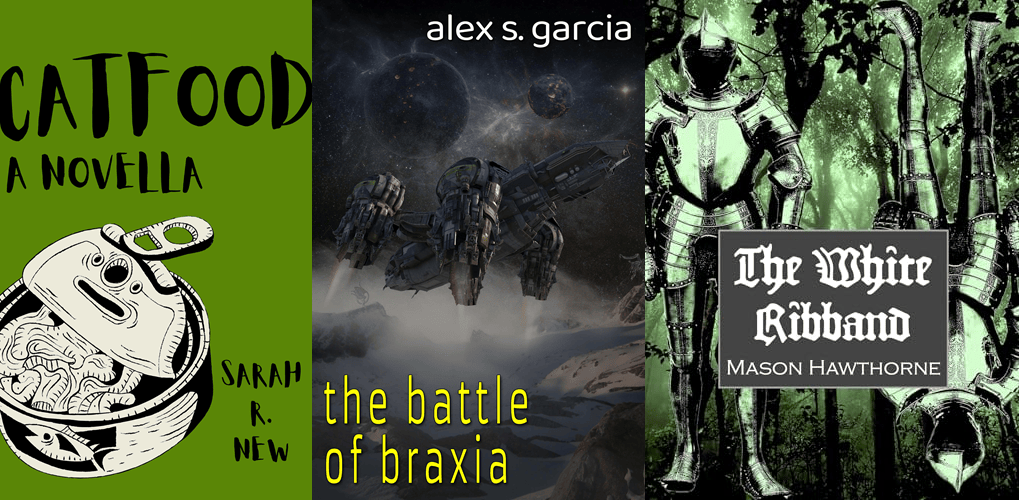
I’m back with another Round 1 review post for The Speculative Fiction Indie Novella Championship! Read all about my team, the Readers of the Lost ARC on the official SFINCS site here or on our team lead’s site here! You can find links to all our sites and/or socials, and read the reviews as they come out! You can also read all my reviews in my SFINCS tag here!
As last year, I will post my reviews here on my blog, and also put them up on Goodreads, Storygraph, and Pagebound.
Here’s what I thought about my last three reads!
Sarah R. New: CATFOOD
A little cat is born and immediately she is in trouble, torn away from her mother, thrown out to the side of the road. Luckily, she is quickly found by a kind soul: a young man, Elias, takes her in, names her Pina (after Pina Colada!), and she quickly gets acquainted with Elias’ other two cats, Artichoke and Biscuit. Things are really good for a while, but soon enough, an ominous intruder makes all their lives a living hell.
CATFOOD is written from the POV of Pina, the young cat finding a home with a new family after her traumatic beginnings. Her voice is very young, innocent, and naive, which will eventually stand in sharp contrast with the horrible atrocities that start to happen in the home that once meant safety for her. From the cozy, lovely mood, the story slowly devolves into desperation and horror, and the depiction of psychological abuse and domestic violence unfortunately feels very real and cruel. It was an especially emotionally grueling experience to watch it all through the eyes of these cats who could do nothing to stop what was happening and themselves were hurting at the hands of the abusive boyfriend. I cannot deny that it disturbed me, and that I was happy when the cats did end up having some degree of agency and the story turned towards a sort of revenge fantasy. In the end, however, this aspect held no true relief either, as their descent into revenge only resulted in more suffering. CATFOOD is a bleak story, and although there might be a small glimmer of hope at the end, ultimately it left me in a hopeless, desolate emotional state which was, admittedly, probably the goal! At the same time, while the cat POV was an exciting choice, I felt like it could have been used more extensively. Pina’s perspective often seemed too human and somewhat inconsistent, and I think the degree at which we delved into the cats’ personalities was not enough for me to appreciate the way the three of them acted and changed in the wake of the events. I was also maybe missing some indication from the end about Pina’s life going on, for some closure, but I can also imagine that that would have maybe lessened the horror itself, so, I’m a bit uncertain there!
Nevertheless, for a unique perspective, a revenge story committed by cats, and some icky body horror (heed the content warnings on the author’s website!) I do recommend this one to lovers of harrowing experiences!
Alex S. Garcia: The Battle of Braxia
Exhi lives in obscurity in her backwater planet society where reading and learning are forbidden for her as a woman but at least she is in relative peace—right until she’s chosen as her tribe’s next padhin, a type of seer-woman who guides their council. The position comes with respect, but also with a weird little slug placed into her brain that causes her strange visions and a very short foreseeable lifespan. But when Exhi’s first vision is about the Imperial Army encroaching on their planet, everything changes. The soldiers come in peace, on their way to fight a war with dangerous rebels, but they might be Exhi’s only chance of escaping her narrow, doomed life, too.
The Battle of Braxia brought to mind classic, old-timey space opera for me, with “barbarian worlds”, shining and corrupt imperials, and righteous rebels, and the story is, in its roots, about a simple person escaping into the wide, wild universe and learning about its complexities. Exhi’s POV is relatable, and she’s the only character whose personality opens up to us in depth, so the reader is along for the ride as she makes a precarious place for her among the soldiers, then, as the war with the rebels progresses, starts to doubt that place. There are also interesting segments investigating her relationship with the creature in her brain, and I wished for more details on this the whole way through: how her tribe found this slug, how they exploited it, how padhins of the past lived, whether other tribes do this too, what is the slug and is it really a sentient creature etc. But I found the implications to the workings of her patriarchal society interesting. At the same time, Exhi is a civilian in a military environment which unfortunately doesn’t allow her to express much agency throughout the story, even though I found her emotional journey and commentary interesting enough. The pace of the novella is pretty slow at first, then it steadily picks up for the second half where we get action after action with an explosive finale. The writing is straightforward and without much embellishment or descriptive sections, and I found this both helped and hindered my immersion. Considering where Exhi ends up emotionally (and physically) at the end, I wished for more exploration of the rebel leader, Corenth, and their relationship, before we got there.
The Battle of Braxia is a quick-paced space adventure with a relatable protagonist and a plot of destruction, betrayal, loyalty, and hope for lovers of classic sci-fi!
Mason Hawthorne: The White Ribband
A knight wanders the woods, exhausted, confused, his memories of what he’d come here for hazy and unreachable. His armor is half-gone, his only personal belonging a white ribband across his chest, dirty and worn. The light is strange around him, and the trees are closing in like a labyrinth, but he finally, he makes it to a stream. The sunshine plays tricks on him, conjuring up things that cannot be, but as the visions scatter, he notices a man struggling in the grasp of the quick-flowing water stream and jumps for him, pulling him out of his watery prison…
The White Ribband hit me across the face with its delectable prose and mesmerizing setting, and it didn’t let me recover until I finished the novella nearly in one sitting. The writing was so enticing and gorgeous, and it fit the story flawlessly—admittedly, I have no idea about old-fashioned English, but it sounded and felt cohesive and beautiful to me. The style also did not impede understanding, the vivid descriptions backing up the dreamy/nightmarish mood. As the two knights make their way through the bewitched forest, encountering strange and horrifying creatures, running from impossible monsters, and saving each other from manipulations and visions, I was reminded of myths and fae-legends, and interestingly, the movie The Green Knight, a similarly fever dream-ish, incomprehensible journey. The relationship between the two men evolves from comradery through quick friendship to attraction and devotion, which also completely fit the setting and was, to be honest, endearing as hell. There’s also an extended smut-scene which I only mention because I’m famous (to myself) of being jarred by these, and they often distance me from the characters and the story, which did not happen here at all. And even though I haven’t much to say about the characters of Sir Medraut and Sir Gaheris, they were both more than enough to carry this very strange journey on their strong backs. There’s a lot that remains unexplained by the end, but I feel like stories like this turn off my logic-seeking half-brain in a very good way, and I’m just glad I was along for this absurd, terrifying, but beautiful ride.
I recommend this novella to fans of the fey, the strange, and the folk horror, of knights who fight and smooch, and of lovely writing.


Leave a Reply