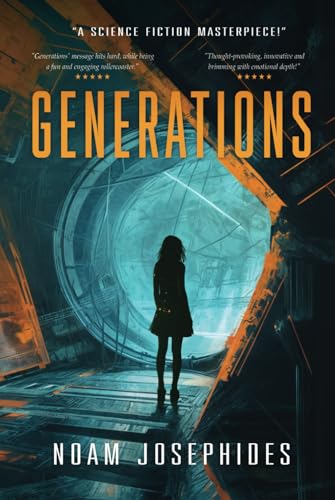
I read this novel for The Self-Published Science Fiction Competition, SPSFC. The following review is my own personal opinion as a judge and does not reflect the views of the team as a whole. Find out more about the competition here and my team, The Space Girls, here, and read all my reviews for the competition here!
A secret buried for generations. A conspiracy that threatens humanity’s future. And one woman who must risk everything to uncover the truth.
The Thetis is humanity’s last hope: a generation ship carrying the last remnants of Earth to resettle on a new planet. For two hundred years, its society has flourished under the banner of unity and cooperation. But beneath this carefully maintained facade lurks a truth so devastating it could spell doom for their entire future on their new home.
The key to uncovering the truth lies in the hands of Sandrine Liet, an introverted Archivist who has everything to lose by pitting herself against the most powerful people on the ship. The deeper she digs, the more evident it becomes that there is only one way to save both herself and her fellow Thetans from the ominous scheme plotted by the Thetis elite – and it’s the most horrifying choice imaginable…
It was Archivist Sandrine, the smart, resourceful, and tenacious main character of Generations who pulled me into this twisty story immediately. Her voice is dynamic and sympathetic, and she leads the reader right into the action as she is entrusted with taking some important documents to Thetis’ mayor (or Primo, as they call it) himself. It turns out the Primo has been threatened at some point in the near past, but now, strangely, wants to somehow disappear all evidence pointing to the event. But Sandrine gets curious. Her boss, Nyasha, who is a bit like a father instead of a father, asks her to drop the case, but Sandrine just cannot. After actually finding and talking to the scientist who did the threatening/blackmailing and then diving into the archives of the ship and discovering some very strange and seemingly impossible modifications that have been performed and hidden in the system, she is even more convinced that something insidious is going on. And with the Primo elections and the Final Call—the decision as to which destination planet should humanity choose as their new home—looming close, if someone is manipulating things, that might cost the Thetans nothing less than a future of humanity.
The entire concept of a generation ship has always fascinated me, and this book delivered on it thoroughly. I loved getting to know life on the Thetis, what kind of living conditions, mentality, jobs, or entertainment these humans who never stepped onto the surface of a planet had created for themselves. It was endlessly interesting to learn about the structure and workings of the ship, the history of their embarkment, and the strictly regulated phases their society went through as generation followed generation in a closed environment in precarious balance. With Sandrine’s narration, all these aspects were told efficiently and just when we needed to know about them.
In the meantime, the action always moved forward. To be honest, a lot of this book is conversations as Sandrine tries to recruit allies and digs deep into the strange conspiracy she found herself in that apparently no one knows about, or at least, no one has all the right pieces to put together. That is not to say there are no proper action (chases, spacewalks, stealthy or explosive escapes) or that these conversations don’t fill up the role of action diligently: things are often tense, mysterious, or seemingly impossible to solve. I also could not help but root for Sandrine since she had so much to lose: she was already a sort-of outcast, even against her prestigious role as Archivist, and could have lost her last chance to contribute to humanity’s survival the only way Thetans were really allowed to: by continuing her bloodline.
By the end of the book, we do untangle an impossible conspiracy, one that truly threatens humanity’s survival and opportunity to remain humanity. The solution is elegant, the threads are expertly woven together: it is a satisfying ending. I really enjoyed my time with the book. The only criticism I could bring up is about exposition and world-building: to be frank, there is a lot of info to convey and to me, the pace of info transmission did not always work. At the same time, the info itself was always interesting, so…take that as you may.
I’m convinced epic sci-fi concept and conspiracy lovers will find a lot of enjoyment in this book!


Leave a Reply