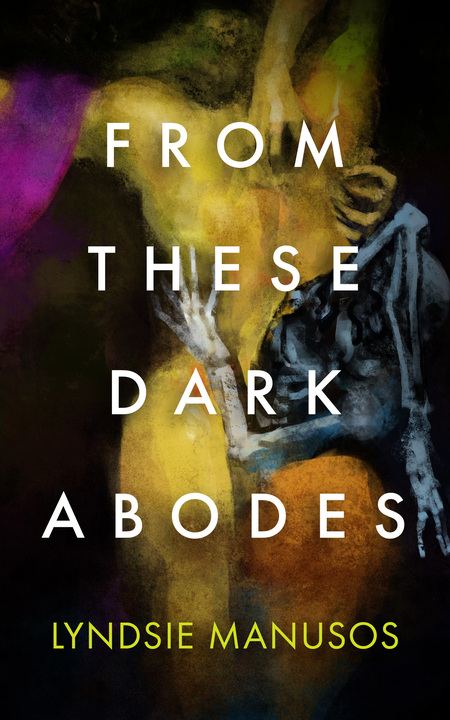
I read this novella for the indie novella competition, SFINCS. The following review is my own personal opinion as a judge and does not reflect the views of the team as a whole. Find out more about the competition here and my team, The WIPs, here, and read all my reviews for the competition here!
From These Dark Abodes by Lyndsie Manusos is a dark fantasy-horror novella that starts us in the enigmatic mansion of St. Edah’s, as we watch Lethe and Petunia, two servants, struggle with their appointed work as they tend to a group of immortal creatures who throw exuberant parties every night, unzipping from their skins and dancing as skeletons. Neither of them remember how they got here, although Petunia has vague memories of a previous life, a child. Both of them are searching for the way out, but the mansion is a prison, impossible to break out of. And even though the lady of the house, Erinyes, keeps giving hints that Lethe should be, used to be, could be something different, something more, Lethe only wants to help Petunia. And when one of the immortals disappears, perhaps a chance will present itself.
The entire setup of the novella is like a fever dream, and the description of the reveler skeletons is absolutely horrifying and some great gory imagery. Just like Lethe and Petunia, I was kept in a constant state of confusion and fear, trying to make sense of the things I was seeing, learn the strange internal logic behind the events. I was very much taken by the situation and the sort of uneven but powerful characterisation of both human protagonists. The inscrutable gods and their inhumanly secrets made me think about Kerstin Hall’s work, just like the moody, poetic-without-being-purple writing style. When the events started unraveling in truth, I had no idea what to expect, and indeed the novella surprised me with the directions it took in the second half, expertly pairing human problems and emotions to the dark, twisted, abstract imagery and setting. Despite the wild turns the plot was taking (talking rat? postpartum depression?) I always felt there was a strong underlying goal and intention from the author that I could trust will lead me to a satisfying ending.
And that’s exactly what the novella did. There were many things I wished were more fleshed out in that second half after the revelation of how Lethe and Petunia got to St. Edah’s and why, but as we rushed towards the resolution, I could let go of them. It was a glimpse onto a mythology, a slice of a larger story we haven’t seen the beginnings of and won’t see the end, and what I really, really appreciated, that it was, chiefly, Petunia’s story, with its simple, horrible, human roots. I’m not enough of a literary critic to define exactly how the novella achieved this, but all its little pieces that were, looking at them for the first time, a truly wild assortment of symbols and characters and themes, somehow smoothed into such a satisfying, bittersweet, consistently interesting and exciting read with just the amount of layered-ness that I like, that it has easily become one of my favourite reads in the competition.
Lovers of vibe-y, dark, dreamlike prose and fantasy stories that wrap very real emotions and events into the weird and the unknowable will find their enjoyment in this one, I think.


Leave a comment