Here I am with the next 10 books on my roster as part of Team Space Girls for SPSFC5 Round 1, and what I voted for them going forward into Round 2. To see the first 10 and my opinions, click here, the last 5 and my opinions are here, and you can read more about SPSFC, The Self-Published Science Fiction Competition, over here!
(Note: me voting yes or no for a book does not mean its ultimate fate in the competition, as there are four others in my team who will influence the outcome!)
K. B. Gazeena: Insider (read up to 33%)

The novel leads us into a future Earth where, after a period of wars and destruction, three big corporations are ruling society, controlling life and punishing crimes with their highly developed technological advancements. Lin lives in Beijing, working a menial job with constant fear of her illegal immigrant mother getting caught by the authorities, when she gets the chance to become an enforcer for one of the big corporations, promising her money, influence, and stability. During her training, she also gets more involved with a group of outworlders who, just like her mother, returned to Earth from the rough life of the interstellar colonies, now demanding better circumstances for themselves. As similar outworlder groups resolve to more violence in this fight, and the desperate, lost heir to a corporate leader, Cenric, also gets involved in investigations of the outworlders, Lin will soon have to choose who she will fight for.
I was really intrigued by the setup of this book and very taken by the outworlder colonist angle which echoes so many complex things regarding our current time, too. I thought the situation of Lin was very interesting and so far handled with a lot of care, promising thoughtfulness in the discussion of these issues. The plot is starting somewhat slowly but was already bringing in many interesting aspects both regarding technology (Lin’s implant) and the different characters and forces present in the outworlder resistance/freedom fight. Where I felt a bit of lack was the characteristation: there were a couple of cool tidbits or dialogues involving both Lin and Cenric, but I unfortunately didn’t end up very attached to them emotionally and was needing a bit more consistent and deeper POV with them. There was also a third plot thread with two other characters that had not yet joined into the bigger story, and that felt both interesting and a bit vague, too. Due to these things, I voted first a maybe, then a NO for this book to go forward. But I think it could definitely be an interesting read.
Nikki Null: Our Simulated Selves (read up to 32%)
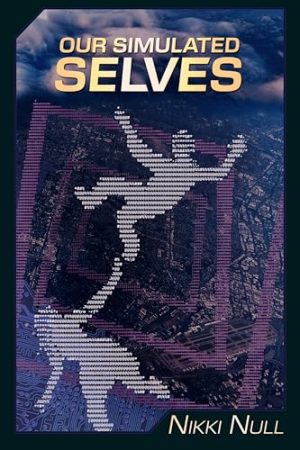
Ren works as a programmer for a supercomputer simulating, modelling traffic movements throughout his city. He leads a simple and mostly unenjoyable life, always feeling like an outsider, always feeling like there’s something wrong with him. That is why he gets so interested in the newly emerging brainscan technology: if he could analyse his own brain, maybe he could find the problem. Maybe his life could get better. To achieve this, he buys an illegal brainscanner from a programmer of a rival company, Jeanne. And Jeanne…Jeanne gets to him. They end up spending a lot of time together, and Ren starts getting attached. And then Ren asks her out. And then Jeanne rejects him. And then Ren restarts the simulation.
It was really hard to stop reading this book when I got to the required percentage, and I really can’t wait to get back to it. Ren’s struggle with his self-image, his insecurities and “wrongness” was so well-represented and described. He is a very flawed human being, but I was endlessly sympathetic, too. His interactions and starting friendship with Jeanne were great, and parts of this book ended up almost cozy: the queer cafe, the tabletop RPG afternoon… all the while it was apparent (from the first scene) that things would go wrong, and what we’re seeing is Ren playing back the events and trying to make them better. It was so relatable, so sad, and just when things got even more interesting, I stopped reading. I also love love love the queer/trans theme, and I’m excited (and heartbroken) to see the journey. I’m really curious where the story will go, and it’s an enthusiastic YES from me.
David Hoffer: Prophet (read up to 32%)
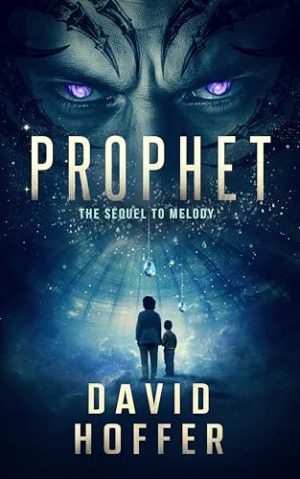
Humanity has been sent plans to build a machine to contact aliens. But one of the people (himself revealed to be an alien) who had discovered the information is killed, and his daughter is in danger from forces who would rather destroy this chance than use it. Now astrobiologist Megan McCullough has to clean up after these events, protect the child, and continue the research, because although the machine, the Beacon, stands, enigmatic and functional, it is still not clear how humans could or would use it. There is another transmission coming, and deciphering it will bring the next big change in Earth’s story.
Prophet is a sequel. This was evident from the beginning, and although the story can be followed well, since the events of the previous book are explained (and not even in an infodump way, I quite enjoyed that!), I was constantly wishing I was familiar with that book first, before reading this one. Regarding the writing, it’s very easy to read, it immersed me immediately, has a sort of thriller-y feel to it. The characterisation isn’t too deep most of the time, but everything that we hear/see about the machine and the aliens are interesting, and there’s a cool religious/cult thread as well which becomes pretty central going by what happens almost exactly at 30% of the book. I had big Contact vibes from the whole thing. I just couldn’t get over the distraction by the fact that there is a whole other book I’m missing. This is probably most of the reason I’m voting NO, although I urge everyone who likes the themes of the book to read it (starting with the first book)!
Eira Brand: Run Like Hell (read up to 29%)
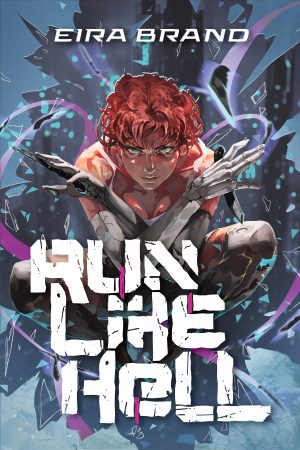
Raide lives in the Metropolis of New York city, doing odd jobs as a courier. But for some time now, jobs are scarce and Raide, quite honestly, is starving. A chance encounter with an old friend who has recently dropped off the grid dumps another load of problems on the shoulders of our protagonist, some strange tech everyone seemingly wants. And thus starts a chaotic flight to escape corporate enforcers and shady dealers/spies through the labyrinthine, stratified layers of the city and perhaps beyond…
This was a strange one! I was instantly immersed in the story of the protagonist, the characterisation was really well done both for Raide and various side-characters, and I liked the cyberpunk-like setting as well. But although things were explained and I got the gist, a lot of the important aspects (the degree of body modifications present, the feel and look of the setting) remained quite vague for a long time or introduced a bit late. There was huge urgency to the initial escape sequence(s), which was great, but at the same time, I also wished for either even more urgency or a bit more space and exposition (weird, I know). But fundamentally, I enjoyed reading it, and I’m intrigued by where it’s going. I have hope that perhaps in the meat of the plot things will find their place better. So I voted YES for now and will be interested to figure out how the story goes.
Marc Edmond Best: The Cataphract Oath (read up to 34%)
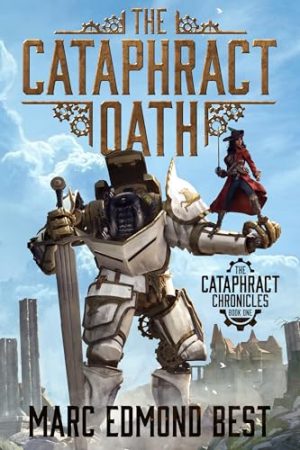
The kingdom of Leovaix is protected by towering war machines powered by alchemy. Victor is studying to become an engineer who maintains and develops these machines, but his thesis presentation ends up a catastrophe, his revolutionary method to improve the efficiency of the alchemical furnace almost exploding both him and his examiners. Disgraced, his only chance to continue his work is a mysterious invitation from the Fenvale family who need an engineer just like him. For what? A salvage job that could restore both one of the most famous Cataphracts of the past, the family’s name, and Victor’s livelihood.
If you’re thinking mecha anime, you’re thinking the right thing. The book was immediately visual in that regard, conjuring up the best parts of a Big Robot Anime, especially in that introductory first chapter. Following that, the world-building is exciting and just enough, and the character work effortless. While we are at war, and this country is constantly under attack from some menacing, rival force (really hyped to hear more about them too), the book also felt whimsical in the first 30%, and although I expect the stakes will get higher, almost cozy at times. I loved Victor and I loved hearing about the Cataphract technology, and I’m very curious to see more of Lady Fenvale’s character and where the story will go. A big YES from me.
Thomas Knapp: The Girl in the Tomb (read up to 31%)
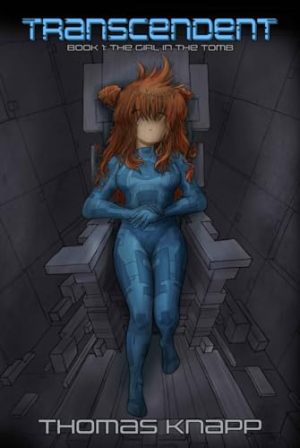
William, an archeologist from the nation of Cascadia, is on a quest to dig out a tomb of a mysterious Transcendent in the slightly-antagonistic territories of the Holy American Republic. We are in the far future where what we now know as North America, has survived several collapses, political, geological, and climate changes and now, and always, is divided. Lots of ancient secrets are lost, chief among them the society of the Transcendents, these godly beings who once ruled the Earth. And what William finds in the tomb, a mechanical, immortal girl who awakens after thousands of years, might change everything in the current status quo.
My first impression of this book was that it’s really detailed, contemplative, and somewhat slow. But it was skillful in its presentation of this huge, deep history and completely changed situation on a familiar/unfamiliar Earth, mostly getting right the pace information was ideally supplied. And when Alyssia, the Girl in the Tomb, joins the fray, everything immediately becomes ten times more interesting. The goal of the characters in this first section is already so big that I’m honestly not sure where the story will go after that (or if it will go anywhere else). But the novel seems to be a long one, and I can see myself enjoying it further. A YES from me.
B. G. Hilton: The Grimsdale Claimant (read up to 30%)

Lord Grimsdale, inventor and owner of the caloric fluid technology that drives the world, is dead. Now a stranger from Australia is claiming to be his long lost son, playing for this huge inheritance. Investigating the case are Gladys Dunchurch, a show singer with peculiar history with Lord Grimsdale and his family, and Charlie Decharles, her friend, who, through his other friend, fiance of Lord Grimsdale’s niece, has personal stake in figuring out what’s going on. There are also many other players in the plot, a mystical cult, a time-travelling madman, two ghosts from ancient Egypt, and perhaps even the alien Bats and Rodents.
Reading that short summary(?), it is unnecessary to say that The Grimsdale Claimant is very whimsical, light, chaotic, and often funny. There’s a lot going on with a lot of characters (and a lot of POVs), which is a LOT to get into at first. The style is also something that might not be everyone’s thing, but after a short time, I was very much enjoying it. I also have to mention that the book is another sequel, and the same thing bothered me here as well: although the context and previous events were well-described, I wish I’d read the first book first! However, this is a case where the storytelling style and the richness and intrigue of the introduced, sort of gaslamp/steampunk world compel me to say YES anyway. I might just read the first book and then come back to this one! I really really enjoyed what I’ve seen so far.
Michael Shotter: The Nemesis Effect (read up to 32%)
Tom Hallett, an everyday corporate worker in his futuristic city, has a chance encounter with an “executive”, the ruling class of his society. When he saves the third-level executive’s life in an unlikely accident, he inadvertently causes his own life to change, too, and gets involved in secret mission to save all humanity.
The book felt like a short read that wanted to pack a lot into it. The introduced society with the masses of “normal” people just doing their work day by day, taken care of and controlled by futuristic, perfect tech, while the executives’ world stands so far from them as if unachievable and divine, was peculiar and interesting. Through Tom, we as readers reach this world with him, but immediately get involved in a sort of whimsical, science-heavy rescue plot, since the Earth is in grave danger from a strange interstellar object. I do wonder how these two aspects of the book (one almost philosophical or sociology-heavy, while the other action sci-fi) will collide later in the book. For now, they seemed a bit disjointed for me. I also struggled a little with the writing style which worked with a lot of long, descriptive composite sentences, affecting the pace and the immersiveness of the prose. For these reasons, I voted NO for the book, however, I think it is definitely interesting for a short sci-fi read if the themes are to someone’s liking!
John Mevissen: The Omega Voyager (read up to 29%)
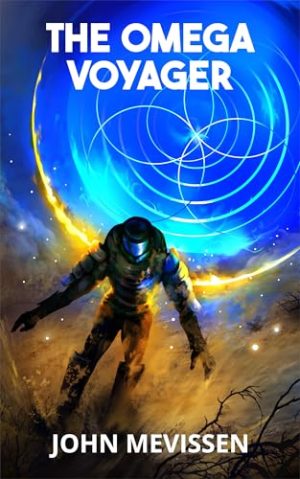
Logan Sheffield needs money. The end of the world, the Omega Event, is coming (maybe) and he needs to survive, alongside his petty criminal friend, Freddie. What’s the solution? Time travel, of course, which has been a popular pastime once but now is a faded curiosity and perhaps also the cause of the apocalypse. But he will do it. He will outsmart the rules and twisty consequences of causality and time loops, and get rich. Or at least, he will damn well try.
The Omega Voyager was a fun one. Logan’s two-weeks-long trip to the past to support a university project (but in reality to play the stock market to his advantage) is the focus of the first 20% of the book, and although his adventures were aggravating sometimes, I enjoyed the way the book was playing with the anomalous or paradoxical effects of time travel such as the grandfather paradox, meeting yourself, or whether things are predestined or not (and what exactly and when causes their predestined nature). Then this section ends, and we’re leaving time travel for a while, then what I assume the main plot of the book will be starts, with another chance for Logan to play time to his advantage. This thread is somewhat of a consequence of the first voyage, but it still felt a bit disjointed to me. And probably on a somewhat more personal note, I just couldn’t get into Logan’s personality, even though I’m almost sure he is intentionally set up as a not so great person. So, even though I’m voting a NO for this now, I think there’s a lot of potential in the book, and I do wonder how the Omega Event will connect to Logan’s smaller scale journey. Time travel enjoyers can safely try out this one.
Aaron Benmark: The Quantum Entanglement (read up to 28%)
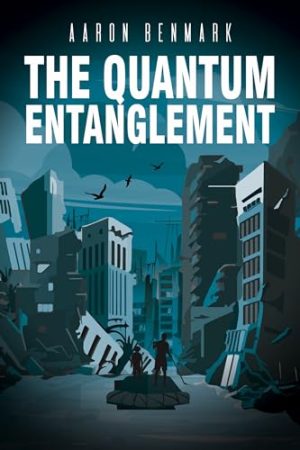
Cort is a historian and researcher for the Church of Science, the religious institution that controls society in a fractured, several-times post-apocalyptic North America thousands of years in the future. Most technology is banned, judged the cause of the great downfall – or banned at least for the common people. The Church can also punish efficiently: theirs is the power of immortality, entanglement, digital afterlife, and they can give and just as easily take that away in case of subversion discovered among their followers. Cort, with his interest in ancient technologies, dances on the knife’s edge with the Church already, and his situation becomes even more precarious when he is sent on a mission to travel the lands and discover and report the forbidden technologies that he finds. Because rumors say rockets are launching from Texas, and things might be about to change…
I really loved how the book started, with the disentanglement and execution of a person who possessed forbidden technology (pennicilin, hah!), it really shows the lengths the Church is going to in its control of science. The entire setup is very well-thought out and interesting, with the fallen cities, changed area names, and clearly set-back society of what once was the USA, alongside the structure and doctrines of the Church. Cort is set up as a normal person but a slight outlier in this tale, a sympathetic presence. There were a couple of sections that perhaps repeated or over-explained the history and certain aspects of the world-building, but with those out of the way I’m looking forward to see what direction the mission will head into after the first couple of days of journeys that the first 30% covered. I really like the theme of technology and science being both necessary and dangerous, there’s a lot one can do with that, and bringing a religious tinge into the mix, it might get really intriguing. A YES to this one.
With 10 more books sampled and a whopping 6 yeses out of them this time, I now have 5 more to report about soon. Then the selection of the top ten will commence, which the team will read in their entirety then rate to determine which ones will progress into the next round!
See you soon!

 Helyna L. Clove
Leave a reply to SPSFC5 – Round 1 Scouting Phase update – Helyna L. Clove Cancel reply