
Happy new year! This year, I’m doing judging for the SPSFC, The Self-Published Science Fiction Competition as a part of Team Space Girls. You can read more about SPSFC over here! I’m still figuring out how I’m going to give updates on the process here, but I absolutely wanted to post something, since I’m doing a similar thing for SFINCS (see my posts over here) and have been enjoying that.
In Round 1 of the competition, 25 novels were assigned to our team (while here is the full list of books participating in the competition), and in the first phase, we are reading each novel up to around 30% to decide whether we’d like to read more. The five Space Girls all vote with a yes and no for each book, compiling a list of ten books that we then read in their entirety and rate/review them. In the end we will send 2 books to Round 2 or the Semifinals!
The first scouting phase lasts until the end of February, then the end of Round 1 is the 10 of May, 2026, so now we are deep in the scouting phase.
Here are the 25 books allocated to our team:
D. Andrews: Afterburn
Samuel Cardoso: Andgate
Adam Bassett: Animus Paradox
Marianne Pickles: Artificial Selection
Ian Young: Ashen Light
Irene DiLillo: Beyond the Last Station
Heather Chambers: Earth Sucks
Alex S. Garcia: Everlife
A. W. Weald: Fimbulvinter’s Fires
Alan Kurt: God’s Gate
K. B. Gazeena: Insider
Nikki Null: Our Simulated Selves
David Hoffer: Prophet
Eira Brand: Run Like Hell
Marc Edmond Best: The Cataphract Oath
Thomas Knapp: The Girl in the Tomb
B. G. Hilton: The Grimsdale Claimant
Michael Shotter: The Nemesis Effect
John Mevissen: The Omega Voyager
Aaron Benmark: The Quantum Entanglement
William C. Tracy: The Seeds of Dissolution
Angela White: The Survivors
John Triptych: Visitor
Elise Carlson: Walking the Knife’s Edge
Sophie Maddon: Your Knowledge Your Life
I am now done with reading 10 of these up to ~30% (I’m going alphabetically, and the exact % depends mostly on where chapters end in the respective book), and here are my first impressions!
(Note: obviously, me voting yes or no for a book does not mean its ultimate fate in the competition, as there are four others in my team who will influence the outcome!)
D. Andrews: Afterburn (read up to 36%)
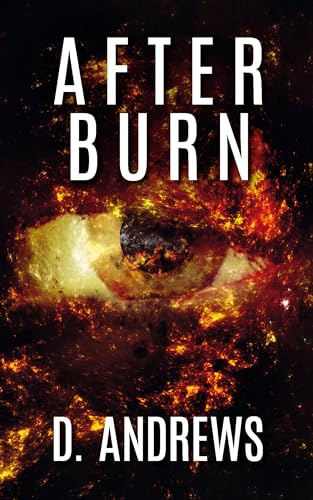
The book starts as a personal recount from the POV of Kara, who is an outcast on her own world: she’s one of the few people there who don’t have telepathic abilities and/but lived to reach adulthood. She navigates a simple life, working in the archives, collecting books, and mourning her only friend, Caethiid, who was killed after returning from a decades-long, mysterious interstellar war. But more and more signs start to point out that Kara does indeed have powers, destructive ones, and when Caethiid unexpectedly returns and wants to…free her? use her? …no matter which, Kara will need to finally decide what to do with those powers of hers.
I really liked the intimate, personal quality of the writing in this book, and how it aimed to convey a sort of psychological thriller-esque feeling in a sci-fi/space opera setting. The prose is great and was very easy to read, conveying Kara’s mental state perfectly. The first third of the book is really bleak and devastating, full of manipulation, lies, torture, and emotional abuse. This was difficult to stay with at times, although I still manage to trust that this section ultimately serves its purpose in Kara’s story arc. On the other hand, the presentation of the mid- and large-scale universe, the interstellar political and military machinations, and the motivations and deeds of different human and alien factions, to my perception, lacked a bit, considering where the plot arrives by the end of the section that I read, and thus I was by that time a little lost and disconnected from those events, even though staying connected with Kara was no problem. One could argue she is just as much disconnected and uncertain as the reader, so this might be on purpose, but ultimately, this was mostly the reason I so far voted a MAYBE to move the book forward. I can easily imagine other readers would have no problem with what I mentioned, and I will re-evaluate and make my final decision after reading all the entries! (later correction: I changed the vote to NO.)
Samuel Cardoso: Andgate (read up to 31%)
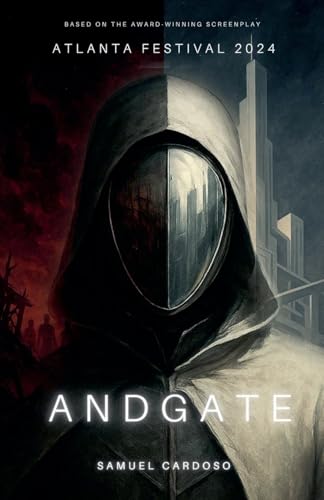
The novel sets up a bleak, authoritarian dystopia future, where everyone has to dress in white, art is forbidden and crimes are punished by exiling people outside of the walled area of the one remaining state after a world-burn. A young man, Nul, deciding he’s had enough of the regime and wanting to turn it upside down, starts a quiet, then a not so quiet, revolution, recruiting people, sabotaging the system and preparing for an all-out struggle to reach his own goals…
Andgate read like an anime for me (yes, I know anime is visual and still!). Specifically, Code Geass, with its masked, morally questionable vigilante’s struggle against the government, although obviously also very different from that. And even in the first 30% we can see Null being deconstructed, and I suspect that would continue going forward: he is fighting the regime with questionable methods, throwing people at the problem as if they were expendable, manipulating his recruits, keeping secrets and agendas to himself, playing around with his new-found power. This was a very interesting aspect of the story, and I could argue the melodramatic, “tell-y” writing style even works with these scenes to make them hit harder. On the other hand, the simplified characterization, exaggerated character-motivations/reactions, and the world-building itself did make the book feel a bit too goofy for me, which drew attention away from the quite serious topics discussed. Maybe some of this goofiness is intended, but it made my reading experience very disjointed, which, alongside some of the missing worldbuilding aspects and a couple of editing issues, was most of the reason I voted NO for moving the book forward.
Adam Bassett: Animus Paradox (read up to 30%)
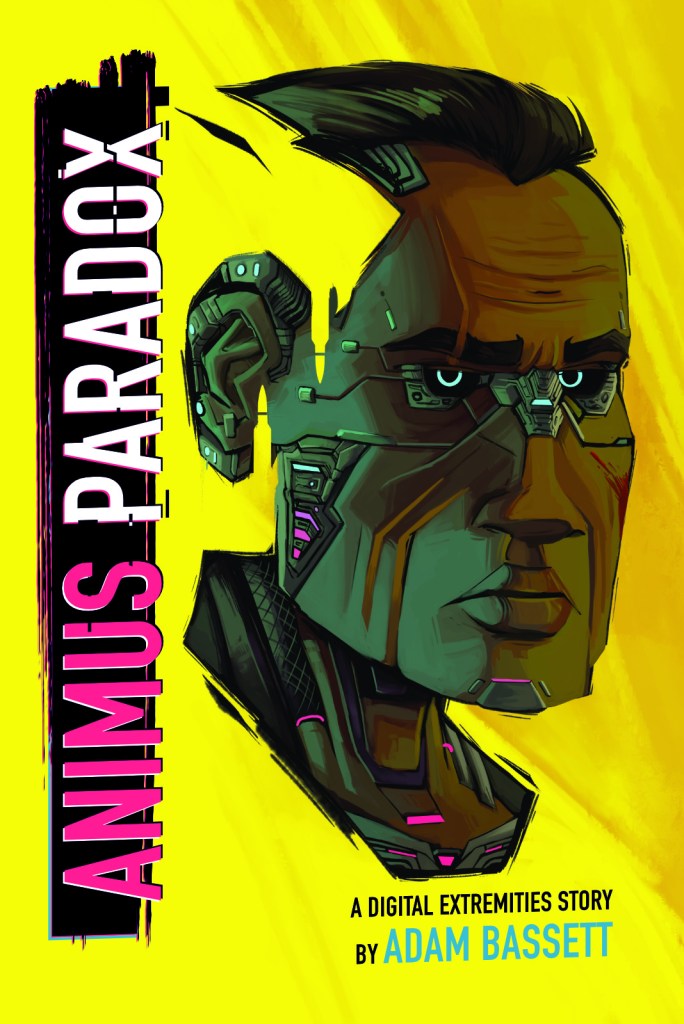
I think this book is a sort of sequel for a short story? Novella? in the author’s first book, which can be felt at the beginning, but the characters, their roles, and their backgrounds quickly get established without any further problems. We are in a sort of cyber-futuristic Italy, following two investigators, David and Mafalda De Campo, who are hired to catch a thief. They need to follow obfuscated leads while several mafia/revolutionary groups try to stick their dirty thumbs into the investigation as well, chasing their own profits and goals.
The pace and tension of this book is insane, almost right from the first page. The plot is fast-moving and although in its foundations quite simple in the first 30% (the investigators try to follow a lead, but in order to do that they have to do some favours to other people) there are many factions and individuals with opaque roles in the case that you really need to pay attention to in order to follow. There are car chases, sword fights, shootouts – it’s full of action and was very easy to read for me. I loved that the main characters are a married couple, and I loved their little moments together. The futuristic city was a great setting which I felt present in, and the body modification aspect for David was also very intriguing and hopefully will play at least as important role later as so far. I did wish for some moments where we could slow down and have some background and character building for the different main and side-characters, but this didn’t take much off my enjoyment. I voted YES for this novel to move forward from the scouting phase and I plan to read it in my own time no matter what.
Marianne Pickles: Artificial Selection (read up to 30%)
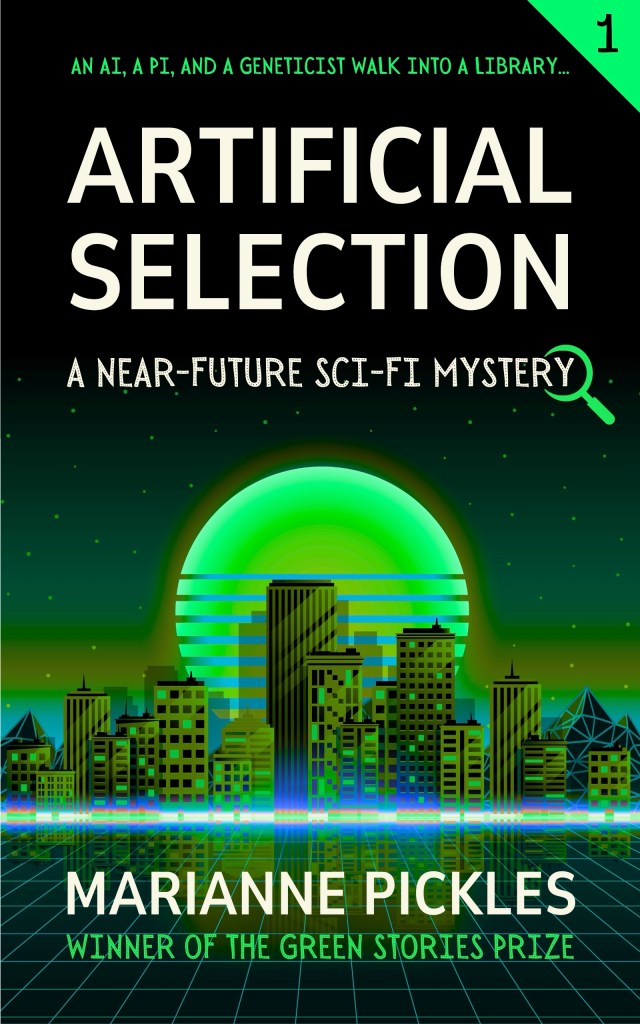
In the near future, after The Melt, the company ArkTech establishes a safe haven on floating ocean platforms close to submerged England, under the governance of Ben, an artificial intelligence. Charlotte works for Ben, helping the AI understand humans better, thus, keeping its mental state stable so it can devote its attention to its many, many tasks. When Ben asks Charlotte why a librarian is letting someone destroy library books, her investigation of this small problem unexpectedly leads to a case that stumps her and raises darker and darker questions about the world she loves so much.
Artificial Selection starts almost cozy, whimsical, and the setup is…well, a bit funny. We’re following someone who is solving little human mysteries for an all-knowing AI, after all. The world we’re dropped in is utopian and seemingly very nice, and the stakes seem pretty low – even though we’re told Ben could glitch out from not understanding humans well, I didn’t take it very seriously. However, as Charlotte follows her leads, there are indications that the utopia might not be that great in many of its aspects. Charlotte is a sort of unreliable narrator, though, with her absolute devotion to ArkTech and its leaders, giving a very interesting contrast. The writing is casual, quirky, and quite smart, giving us worldbuilding and character details bit by bit in a nearly perfect pace. Charlotte is relatable, her backstory is intriguing, and her investigation is so, so enjoyable that it was very easy to get immersed immediately. This one is a very enthusiastic YES from me to move forward, and I will be reading it in its entirety for sure!
Ian Young: Ashen Light (read up to 32%)
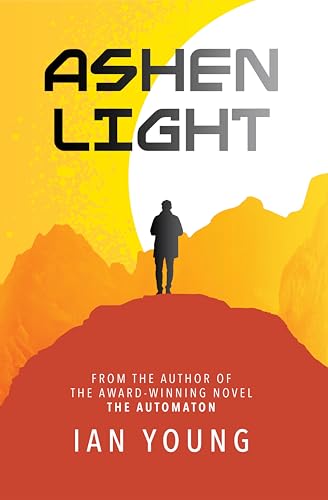
When John Allenbeck pairs up with a street cop to investigate a cut and dry suicide case, he quickly realizes he’s in fact found something truly weird. In a corporate-dystopian future state of SynthCorp, Beck is a disgruntled, sort of rebel cop who has been demoted to his current position and doesn’t expect things to get better any time soon. Right after he starts being suspicious about the “suicide” of this synthetic food expert, news of strange radio signals from the planet Venus are announced, and then quickly suppressed by the company. And the last act of the man who died seems to be a warning about that very signal.
The novel starts like a classic detective thriller, except in the future. With the descriptions of the world as an oppressive corporate hellhole, the setting is really bleak, and I enjoyed seeing Beck’s grumpiness against his workplace and his co-workers (I kinda imagined him similar to Miller in The Expanse series). I also liked the mystery of the radio signal, and the two threads join together (alongside with a third thing that gets mentioned in the beginning a couple of times) right where I stopped reading and promise a cool mystery/conspiracy going forward. Both the plot and the main character have a chance to become more interesting later, however, in this first section I found that the writing style kept me far from the characters, and the main elements of the story were brought in a bit clumsily. The dialogues felt a bit simplistic and the character reactions to some events somewhat rocky. I can easily see this being enjoyable for lovers of the genre, however, these things, alongside with some editing issues, ate into my enjoyment, thus I’m voting NO for it to move forward for now.
Irene DiLillo: Beyond the Last Station (read up to 30%)
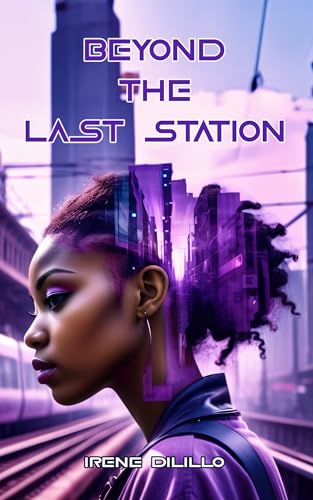
The novel follows main character Kya, a Black woman who lives as a slave in a future dystopian society in a world without natural resources and with a high-tech ruling class. Among these bleak conditions, strange appearances begin to rattle humanity: dead bodies clutching out-of-time artifacts, giving rise to a belief that portals to a different time or planet have started to open in some places. Kya escapes her cruel master and intends to find a way to one of these portals, following her lost love and the promise of another life.
Beyond the Last Station was…interesting. In itself, I like the idea of re-imagining the historical underground railroad as a journey through parallel worlds, a nice twist given the novel’s futuristic setting. I could also see that there was a strong spiritual element to Kya’s journey, and in the author’s introduction, it is clear that she was inspired by the plight and emancipation of African American people in our real past and has written this book to put her vote beside the idea of a diverse, free society where racism is non-existent and both people’s lives and the natural world are respected. However, I found in the first 30% that some of these issues are presented in ways that might seem less than sensitive to the people actually suffering, right at this moment, from systematic racism and from the memories and aftereffects of hundreds of years of oppression. I myself am a white European so I can only attest to this from that point of view, but I felt there was a bit too much emphasis on the detailed descriptions of the atrocities happening to Kya and her people (and especially sexual abuse happening to Black women) and too much allusion to how such repeated abuse might make the victim complicit with the crime, which is a heavy, heavy thing to pronounce so easily. Even though the author might have noble goals in presenting the story like this, and there is value in realistic presentation of suffering, I think the book would profit from a few rounds of sensitivity reads from POC (or a few more, if it was already done) to convey the message both on a conceptual and line level with the necessary respect. I also found the reading experience difficult from a writing technique standpoint. The prose overwhelmingly builds on circular, purple descriptions and stilted dialogues with sometimes a confused sense of place and time, spotty worldbuilding, and very little characterisation. Part of this might be a translation issue, as the author is, I think, Italian, but in any case, a strong native-English editor could help these issues as well. I’m voting a NO for this book to move forward in the competition.
Heather Chambers: Earth Sucks (read up to 28%)
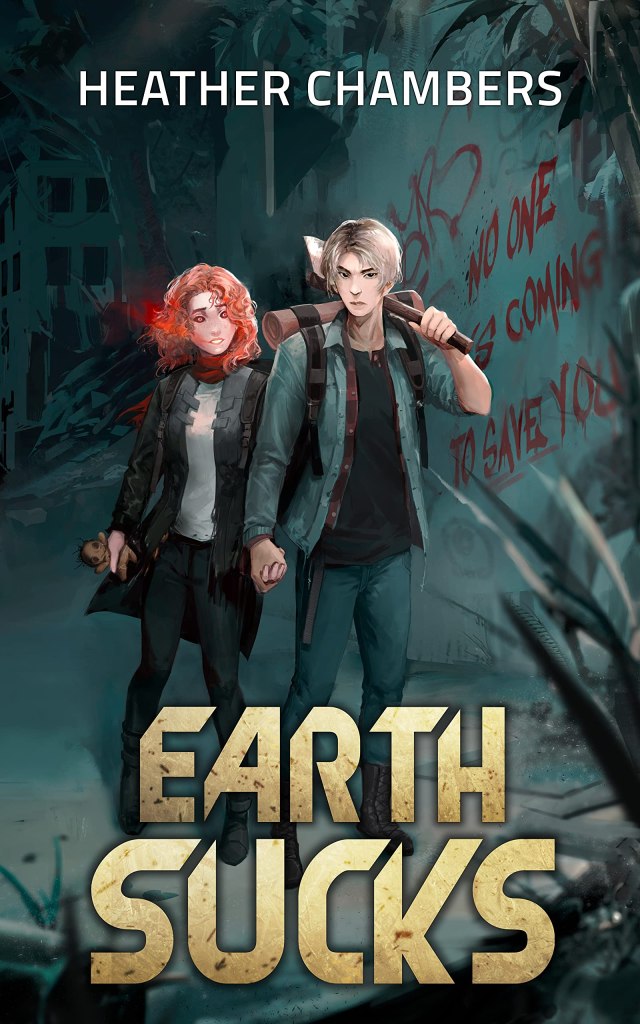
Earth Sucks by Heather Chambers does not hesitate to throw us right into the hectic and dangerous life of Feng, on the run from the aliens who have invaded Earth…an Earth that is already in shambles, struck by natural disasters and the consequences of humanity’s various sins, its people mostly living in walled cities or scattered farms. Feng takes shelter in a house but shortly realizes it belongs to Diem, an alien. Luckily, she doesn’t seem to want to kill him, or at least, not yet. Diem is a healer, fascinated by humans, and she saves Feng, just to bind him to herself as well. Feng, wanting to go back to his friends that he left behind, so he can continue looking for his family, tries to navigate the situation and figure out how to use it to his advantage.
As I mentioned, the novel starts right in the middle of action and continues to be action-filled and eventful the whole way through for what I read. The world and its players are introduced in the middle of these whirlwhind scenes, and I enjoyed getting to know both Feng and Diem, as well as more about the aliens themselves. There are many cool little ideas here, lots of banter and some humor, and the ride was entertaining, however I felt like the tone was a bit all over the place, the goals and stakes and even characteristics and relationships of the main and side characters a bit spotty, and the plot somewhat chaotic already in this beginning part. So, this is a MAYBE from me so far, and I will be getting back to it soon to decide. (later correction: I changed the vote to NO.)
Alex S. Garcia: Everlife (read up to 33%)
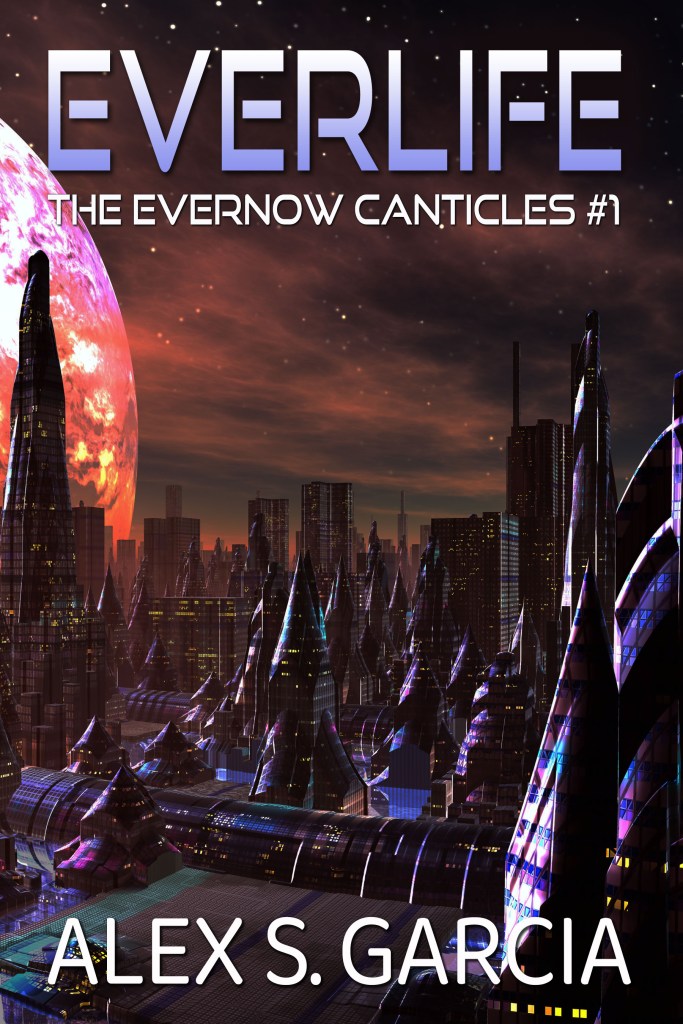
The novel opens with a man’s suicide, or possibly murder, then launches several story threads: one is the investigation of the murder, another is a pair of historians investigating a strange mask, an artifact from the past, another is a magician’s own journey with studying the mask and looking for his mother, another is a third historian looking for a lost city of the gods, and then a couple more featuring other humans and what we suspect non-humans, going about their business in the sprawling universe of the Weld. What connects them is the hidden history of a thousand gods once walking the soil of these planets, now somewhat forgotten, even though their plans are still brewing under the surface.
Everlife is very ambitious. It introduces many characters and many settings and worlds in quick succession, and one has to pay careful attention to follow the disparate threads quickly untangling in short chapters and with quick POV changes, even though some of them join together already in the beginning section that I read. I cannot deny that I got interested, especially in the mask and Paul’s powers. I also especially liked one of the threads which we get from a journal unearthed somewhere in the jungle, about these god-like people (I think?) who lived on the planet in ancient times. Unfortunately however, I didn’t get a good sense of the setting, the different planets, their relations, and histories, which I really wanted to get immersed in, and the structure and writing style didn’t support the characterisation either. I was also sorely missing a more characterful atmosphere for this advanced interstellar empire with an ancient, hidden past. The writing is dialogue-heavy, which is not a problem in itself, but it made the mystery aspect less…mysterious, I suppose. Due to this, I will be voting a NO for this novel for now.
A. W. Weald: Fimbulvinter’s Fires (read up to 33%)
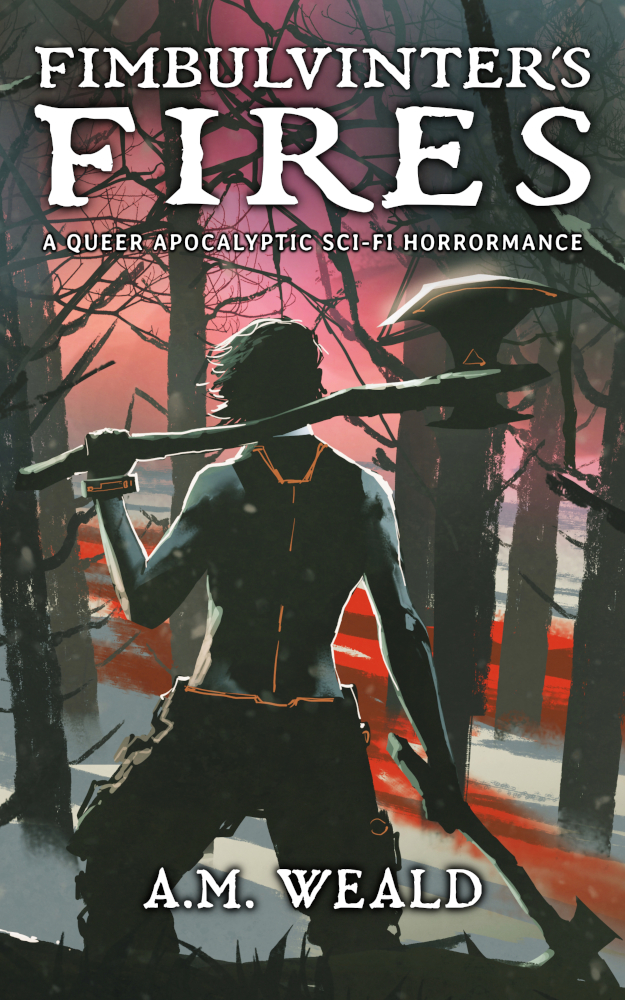
The novel opens with a frantic escape and survival sequence, as our main character desperately tries to orient himself in a crash-landed escape pod, then fights some attackers in a snowy forest area, donning the armor and tech of the person who was his prison guard. Gradually, we get the scenario: Ash (and his partner, Jasin, who perishes during the escape) is a convict, who took part in a rebellion when their transport ship exploded, and he is now stranded in a strange planet, maybe Earth, among wild animals and wilder humans, hungry, cold, grieving, desperate. Then Ash unexpectedly finds help: he is taken in by a tribe of strange humans and guarded, supported by a person who has taken an interest in him.
I really enjoyed the chaotic starts of this book, and the writing style perfectly conveyed Ash’s mental and emotional state. The tech he picks up (a vest and armband that monitors and augments his body and weapons) is intriguing, his story, although still a bit spotty, is interesting, and his struggles are relatable. Both the setting and the deep POV were very immersive and the prose is lovely. I suspect, after reading the blurb and getting some hints and glimpses towards the end of this first 30%, that this might get more romance than sci-fi, however, I’m excited for both aspects, as the writing and plotting is really cohesive and seems to know what it wants to do. Definitely a YES, and will be reading this in its entirety.
Alan Kurt: Göd’s Gate (read up to 30%)
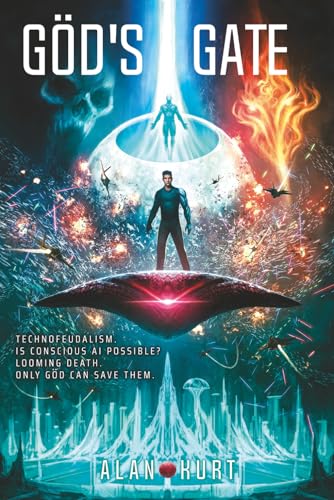
Earth is ruled by tech giants and all-controlling AIs, its small communities of technology-critical people constantly ravaged by attacks of roaming robots and augmented humans. Robert is an AI scientist researching consciousness and brain-mapping, while working for as an AI-output verifier for a company that maintains Prometheus, the large AI governing the nearby megacity. Meanwhile, on another planet, a hunter with mind-entangling abilities rises to warrior status and starts to question the gods her society is tied to. And on the three moons of the United Eumenides, a general fighting for peace and innovation detects a strange signal coming from a nearby star system, with two other, so far unmapped-systems, appearing on their star charts…
Göd’s Gate is another ambitious proposal, going deeply into questions of consciousness, artificial intelligence, its uses, dangers, and powers already in its opening accords. It is clear that the author is knowledgeable and imaginative in many of these topics. The world(s) that are presented are full of great ideas and thoughtful considerations (I loved the idea of Neurover, the three moons, and the mind-melding society of Narada) and although I’m not sure where the novel will lead, it’s all certainly intriguing. I have to admit though, that I was struggling with the prose itself which is really dense and detailed at times, exposition- and explanation-heavy, thus less conductive of carrying a narrative and supporting characterisation. After the heavy exposition of the prologue, the chapters playing out on Earth were the most difficult in this regard, with long sections of speeches and monologues explaining history and complicated concepts. This was also somewhat true to the United Eumenides parts. While the themes and subjects of these speeches were interesting and certainly important for the overarching story, the presentation felt to me akin to a doctoral thesis or a technical essay. To me, this made the reading difficult, as I prefer more organic, gradual expositions in novels. I’m convinced this book is an excellent thought-experiment with deep, interesting worldbuilding which would shine after a developmental edit, but unfortunately, I will vote a NO for it for now.
So that’s it from me for now, with 3 certain yeses from 10 sampled books!
I will be back with the next batch soon! (see those posts here and here)

 Helyna L. Clove
Leave a reply to SPSFC5 Round 1 review: Marianne Pickles: Artificial Selection – Helyna L. Clove Cancel reply