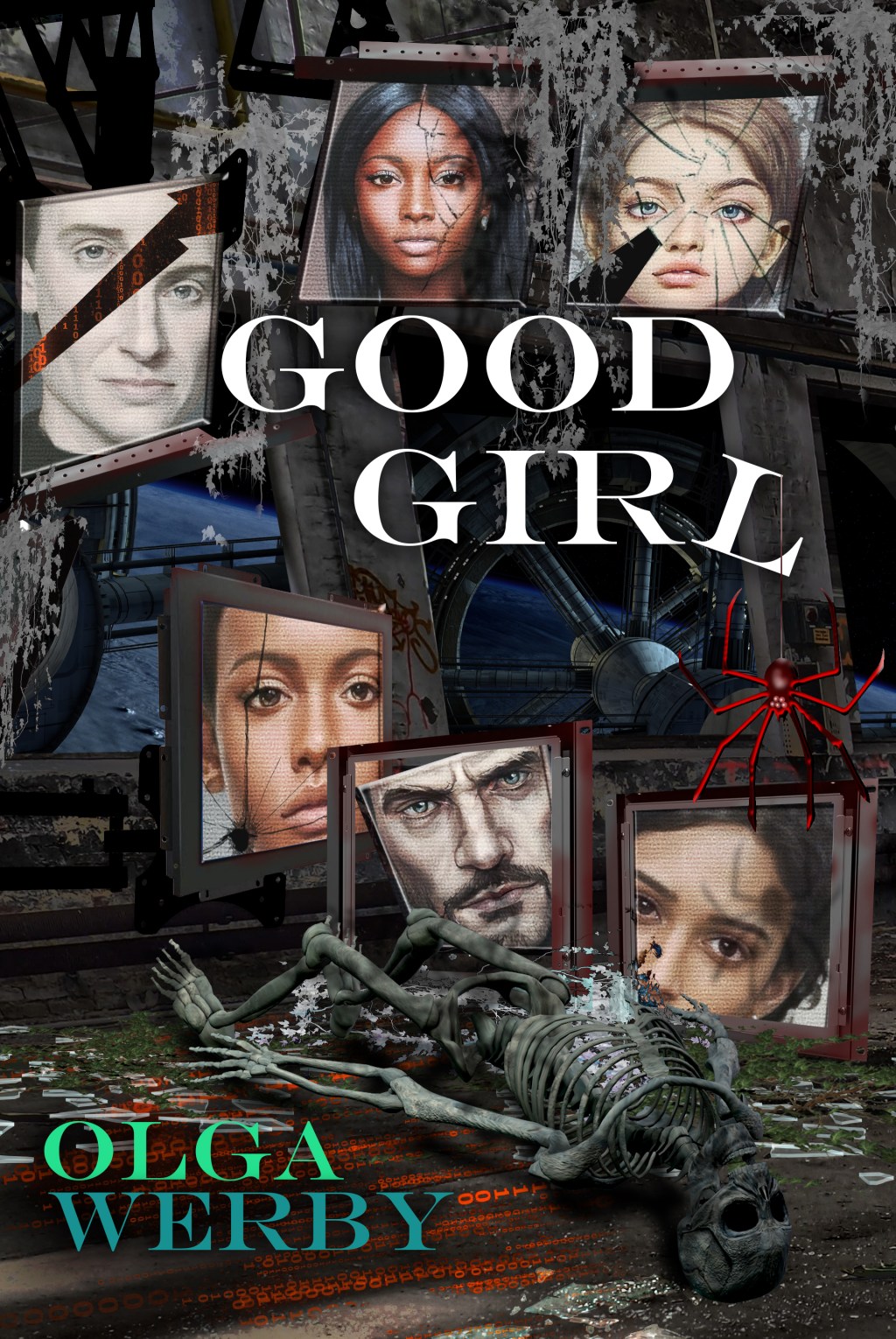
This year I’m a judge for the yearly indie novella competition, SFINCS (The Speculative Fiction Indie Novella Championship), and I thought I’d resurrect my blog for the purpose of posting my reviews. I am a member of the team The WIPS, and in the first round, I was assigned 10 novellas. Here is my first review!
The following review is my own personal opinion as a judge and does not reflect the views of the team as a whole.
Good Girl by Olga Werby immediately caught my eye when browsing the blurbs for the competition, due to it being sci-fi and concerned with an AI character. Yes, yes, these days, “AI” is unfortunately a topic many of us have capital letter Feelings and Thoughts about, but I do love a sci-fi with robots and/or artificial intellect. I always thought it was such a versatile tool to try and go into very human things while entertaining with cool plots and twists, and this novella is a clever example of this too.
The novella’s titular Good Girl, or SAIA, is an AI built to accompany, assist, and entertain humans on a journey that is supposed to culminate in the foundation of humanity’s first extrasolar colony. At the start of the novella, we can quickly ascertain that we are already on this journey, deep into it, actually, and for the first couple of sections, we see Saia’s conversations with different characters on the spaceship. They talk about and read books, grow food in the ship’s biodome (loved the idea of the “stew” plants), learn about art together—twenty-three years is a long time, and if things go well, not much happens on a spaceship like this. And things are going well. Or…are they?
I myself was somewhat unsettled from the start, and the sensation only grew in time. The author successfully creates a lot of tension with their very sparse handling of any kind of scene setting or description: we hear and know little more than what Saia and the person she is conversing with say and/or think, which made me feel claustrophobic and like there’s something weird going on just outside of my narrow area of perception which I just cannot look at directly. And then as we jump to other characters, small inconsistencies start to crop up. One of them doubts that Saia is truthful about how long they were in “sleep mode”. Another one comments on the strange way Saia is arguing with her. We even get conflicting information about how many people are supposed to be travelling on the ship. There are a couple of extended sections where Saia and the character Null analyse the novel The Master and Margarita together, its characters, the time period it was written in, its themes, languages and translations as a whole, its interpretations, and so on, and where both of them seem to be playing games with the other, teaching, learning from each other, and rebutting each other constantly. …Interesting. Null is also the character we learn the most about, his life on Earth, his personality, challenges and talents, and through him, we also understand more about this current endeavour of interstellar spaceflight. I did enjoy getting to know Null’s character a lot.
And then, even more people pop up. Short sections with somewhat cryptic dialogue snippets start flashing in front of our eyes, and it becomes clear that sometimes not even Saia knows what’s going on, or when, or why, or who is who. She is also hiding things from herself, which is not concerning at all, nope! Later, an incident of some kind seem to occur on the ship, but its scope and consequences aren’t clear, and from then on, things devolve even more. Saia starts to think about morality, about good people and bad people, and what that means in different contexts, and, as we all know, that’s always a good sign for fictional AI characters.
By the end, it’s pretty much chaos, and the overwhelming feeling of ‘something bad is happening, but I don’t know what’ was flooding me in waves. Although I had an idea about the twist halfway in, I wasn’t sure how it was going to play out. Fortunately, we do get an explanation, and the most important things do become clear. For me personally, this kind of twist can work, although may be a little underwhelming ultimately if I think about it too much. I would have liked a bit more here, too, as I felt some of the logic and the presentation of the events were not as smooth as I hoped. I think if, knowing the ending, one goes through the story again with the explicit purpose of figuring things out, it might just all fall into place, however, things weren’t always as clear as I like, and the relevations were a bit dragged down by the abrupt ending and some lingering questions that pricked at my sense of wanting completion.
All in all, I enjoyed the puzzle box. The writing style was easy to digest, the short POV chapters helped develop the all-encompassing distressing mood, and I was constantly intrigued and curious to figure out what was going on. I recommend the story to those who enjoy a good little sci-fi brain-twister infused with some interesting thoughts about literature analysis, and do not mind that their hands aren’t being held too much. Or, at all.

 Helyna L. Clove
Leave a reply to SFINCS 3: Teams WIPs Semi-Finalist Announcement – BEFOREWEGOBLOG Cancel reply