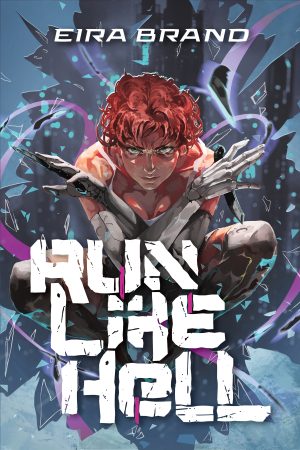
I read this novel for The Self-Published Science Fiction Competition, SPSFC. The following review is my own personal opinion as a judge and does not reflect the views of the team as a whole. Find out more about the competition here and my team, The Space Girls, here, and read all my reviews for the competition here!
Starving to death in the lowest layer of the Megatropolis of New York City, Raide will do whatever it takes to survive.
When a chance encounter with her best friend ends with his murder, Raide soon finds herself risking her life to complete his last gig, all while in search of answers and vengeance.
But with corporate mercenaries on her heels, a strange new virus mutating ordinary people into grotesque monsters, and the sinking realization that this was more than a simple contract gone sideways, Raide is soon left with two options:
Lie down and die or run like hell.
My first impression of Run Like Hell was already suggested by the title: a mad, chaotic dash of the underdog main character through a cyberpunk plotline that had been dumped on her by unfortunate circumstances—namely, her best friend dying right before her eyes and leaving her some weird tech everyone is scrambling for. The first 30% was a bit unbalanced for me but also more than enough to pique my interest. I wanted to know more about Raide who was just about to chang bodies(!), about the strange capsule, about the information blackout drawing over the megacities of this dystopic future capitalist hellscape USA. I also liked the character of Jin and was eager to learn more about the comraderie between Raide, Eshe, and Mahdi.
The mad dash did continue right until the last pages of the book. Without going into too many spoilers, the main story thread involving the capsule entrusted on Raide turned out to be really intriguing, and Raide’s body swap posed interesting problems and questions involving identity as well. In the character of Eshe we got to know a passionate and somewhat mercurial battle buddy to Raide (I especially loved her backstory), and the explanation to the blackouts culminated in a truly gory, viscerally horrifying finale that made me think of stuff like Resident Evil or The Last of Us. And now when I think about it, the story often did feel like playing some AAA sci-fi horror video game, perhaps with both the positives and negatives that come with that sort of storytelling. The meat of the story was sufficiently connected, and most everything got explained by the more-or-less settled ending, but it did feel like to me that the episode-like segments with their own players and themes that the book seemed to be composed of had varying success in playing together cohesively.
First it was Raide’s escape from her building starring Jin and the merc army, then the body swap section with Eshe with the themes of transness/identity/body dysphoria/mind-fuckery, then the trip to Old Manhattan where we dealt with a gory kidnapping by two new antagonists, then back to our original city for the infestation episode with its own little circle of main characters. There were also some flashbacks to develop characters with their own little stories that popped up from time to time. This all put together was quite a lot, and although very dynamic, never boring, and always posing interesting questions, it sometimes ended up a bit overwhelming. Information flow to build up the world and/or the characters and their relations felt sometimes spotty, and things I expected to be really thoroughly developed (I’m mostly thinking of the nature of the capsule, but I could include Raide’s gender-change and her emotions/experiences around it, her sometimes confusing relationship with Eshe, or the flashback involving Mahdi and the tanks) could not receive as much time and consideration as they perhaps needed. The book wanted to pack a lot in it, and I liked almost all of it, but my experience was a bit muddled and chaotic as I constantly tried to sort through the info that I got and infer the info I didn’t to understand the characters and their role in Raide’s life as we trudged ever forward. I did consistently love Raide’s voice and narration, though, and how she tried to mentally deal with the increasing amount of fuckery she needed to go through in the course of the novel. Great stuff.
In any case, the book was an exciting and tumultuous romp that truly never let up, and lovers of sci-fi action, cyberpunk, and fleshy-bloody-oozing monsters will certainly find great entertainment in it. Some scenes will surely live rent-free in my head for a while. If any of this feels like it tickles your fancy, pick up this tornado of a sci-fi book for sure.
 Helyna L. Clove
Leave a comment