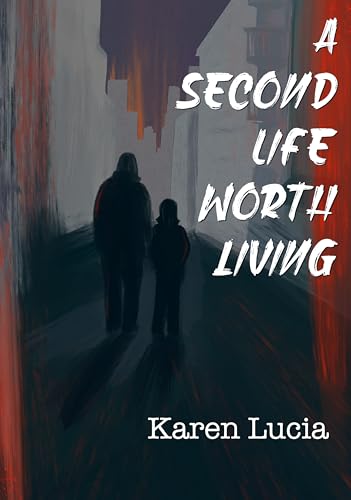
I read this novella for the indie novella competition, SFINCS. The following review is my own personal opinion as a judge and does not reflect the views of the team as a whole. Find out more about the competition here and my team, The WIPs, here, and read all my reviews for the competition here!
A Second Life Worth Living by Karen H. Lucia is a poignant, heartfelt urban fantasy/sci-fi about a young man living under oppressive government control in a world on the brink of falling apart. He dies as a martyr to a revolution he knows very little about, then he, miraculously, comes back to life. The novella is the exploration of what humans can do in the face of world-changing events, and how to stand up for what is truly important for you.
I must say, it was very difficult to read this novella, and it’s also quite difficult to review it now. It is working with such current, painful themes that it cut really deep when, after the first couple of chapters, I realized what it was trying to do. Ben’s story could be our story, I think. Any of us, living in times of turmoil and tragedy. He is nothing special: he spends his days at home watching bad TV, has only a couple of friends, works menial jobs (when he’s not looking for a job), and he’s very far from what we could call an activist or a hero. It is only after his first death that he, begrudgingly, starts to consider whether there is something more he could do with his life. And even then, it is the prospect of a romance that shakes him out of his stagnation, and it is only chance that brings him into…not even the center of a revolution, just to the outskirts of it. The novella ends up being a thoughtful consideration of the levels of action, support, and resistance a human or a group of humans can exhibit against a regime trying to enact more and more violence on them; the moral considerations of the use of violence itself in fighting back, or whether protecting those that you love rather than joining the fight in an active way is “enough”. And I felt like the novella tried to show all sides, and did not outright tell me what was wrong or right, and I very much liked that. All answers depend on the person and the situation, and all actions we do to help might have risks, dangers, and positive effects to them.
At some point during reading, I noted down that the novella is “incredibly straightforward and direct with its theme so far, which at the same time I like because if there’s a theme to be straightforward with right now, it’s this one, but on the other hand it lessens my involvement a bit.” This stayed true for the whole span of the story, although I definitely got much more emotionally involved by the end. Plus, I definitely appreciated that even though some dialogues ended up a bit stilted since they were so full of discussions of the themes (especially towards the beginning), I never felt that it was preaching something to me. Well, if it was preaching anything, then it was how you shouldn’t bow down in face of violence enacted on you and your community, and that is something probably everyone can agree on. The degree and method of “not bowing down” after that is on you: small acts, mutual aid, creating community, supporting others physically or mentally are all good ways of standing up, even if one cannot or is not willing to be on the front lines, throwing grenades. Which can also have its place, and sometimes, unfortunately, is one of the only ways to reach for a better life.
I could probably rant about my thoughts and feelings about this novella for much longer, and that definitely means that its direct, honest, casual, but well-thought out prose and theme had a great effect on me. I loved how we saw more and more about Ben’s personality as we went on, especially through his love and care to a young kid that ends up having to rely on him, and also how the different side-characters all had their own thoughts and ways of relating to the main theme. I even liked the magical side of the story, which the story did not go into very deeply, but for example with the representation of Second Lifes, Lucia even managed to bring in some important viewpoints about the “others” in a society like this, vulnerable and easily made a scapegoat.
I’m really happy I had the chance to read A Second Life Worth Living, and I’m really happy it exists. And if any of these themes sound interesting to you, you should definitely read it.
 Helyna L. Clove
Leave a comment